Reference

    Hotel review scores across OTAs: why the same month produces five different numbers

    An 8.6, a 9.0, a 4.6, a row of bubbles and a blank, all describing the same hotel in the same month. Four of them are not wrong. Each platform asks a different question, of a different set of people, on a different scale, over a different window — and only some of them publish the arithmetic. This page records what each number is actually built from, using each platform’s own documentation, and why no conversion between them exists.

    Every scale, population, derivation and window below was checked against primary sources on . Where a platform publishes nothing retrievable, the entry says so instead of repeating what the internet says about it.

    The short answer

    Your review scores are not five measurements of one thing. Booking.com scores each review 1–10 and weights the total towards recent reviews, accepting a review only within three months of check-out and showing it for up to 36 months. Agoda also displays 1–10, but builds it by averaging five category ratings guests give from 1 to 5 — the only published arithmetic on this page. Expedia Group shows a 10-point score on Expedia and Hotels.com while publishing the same ratings from 1.0 to 5.0 in its Rapid content model, with a separate average and review count for each brand. Google averages every rating published on Google, from reviewers it does not require to have booked or stayed. Airbnb shows nothing at all until three guests have rated. Trip.com and Tripadvisor publish no retrievable explanation, so this page makes no claim about either.

    What most operators get wrong

    • Converting between scales. Expedia Group publishes one dataset on two scales, which is a rescaling inside one company — it is not permission to halve a Booking.com 8.6 and compare it with Google's 4.3.
    • Treating two 1–10 scores as the same instrument. Agoda's total is the average of five category ratings; Booking.com's is a recency-weighted aggregate with no published relationship to its categories.
    • Expecting Expedia and Hotels.com to match. One Partner Central listing feeds both pages, but each brand carries its own average and its own review count.
    • Reading a blank as a bad score. Airbnb publishes a three-rating display floor, and Google's review-feed documentation says a listing with no valid reviews is not shown at all.
    • Assuming your OTA score stays on the OTA. A hotel's Google Business Profile may show travel-website ratings with a link, and Google states you cannot choose which website a review comes from.
    • Trusting an article that gives you the formula. No platform reviewed here publishes its weighting, which means nobody else read it in the documentation either.

    A review score is a number plus three qualifiers

    Before two scores can sit beside each other, four questions have to have the same answer. They almost never do. Google’s own feed format is the neatest illustration: it will not even accept a rating without being told what the scale is, and assumes 0–10 if nobody says.

    The scale

    Out of what?

    A score is uninterpretable without its maximum, and the platforms do not agree on one. Google’s own feed documentation makes this explicit rather than implicit: the rating is a number “typically from 0-5, 0-10, or 0-100”, and a separate rating scale attribute carries the maximum — defaulting to 0-10 when nobody declares it.

    What the documentation says: Booking.com and Agoda display out of 10. Google and Airbnb display out of 5. Expedia Group’s websites use a 10-point scale while its Rapid content model publishes the same ratings between 1.0 and 5.0.

    The population

    Who was allowed to score you?

    Two averages over different populations are different measurements even at identical scales. The gap between a guest-only population and an open one is the widest difference on this page, and it is the one no rescaling can repair.

    What the documentation says: Booking.com: someone who booked through it and either stayed or arrived without staying. Expedia Group: a traveller verified as having booked with it, who may receive a savings voucher for reviewing. Agoda: real guests, after check-out. Google: no published booking or stay requirement, plus ratings carried in from travel websites. Airbnb: not stated in the article reviewed.

    The derivation

    What exactly was averaged?

    This is where two platforms sharing a scale stop being comparable. One total is the average of category ratings; another is an aggregate weighted towards recent reviews; a third is the plain average of every rating published.

    What the documentation says: Agoda: five category ratings given 1–5, averaged onto a 1–10 scale. Booking.com: a weighted system in which more recent reviews have more impact, described but never quantified. Expedia Group: an overall rating averaged from all guest reviews, plus nine category averages. Google: the average of all ratings published on Google for the place. Airbnb: the average of guests’ overall rating scores, shown from the third rating onwards.

    The clock

    How long does one stay keep counting?

    The same operational improvement shows up at different speeds on different channels, and a score with a short window is a different instrument from one with no published expiry. It also decides whether asking an old guest for a review is possible at all.

    What the documentation says: Booking.com: submitted within 3 months of check-out, shown for up to 36 months or until the property changes ownership. Expedia Group: all available reviews over a 2-year period, in the XAP data record. Google: up to 2 weeks for a new review to move the score, with no published ageing rule. Agoda, Airbnb, Trip.com and Tripadvisor: not published in the sources reviewed.

    Scale by scale, and what each total averages

    Read each row and ask one question: what would have to be true for this number to mean the same thing as the one above it?

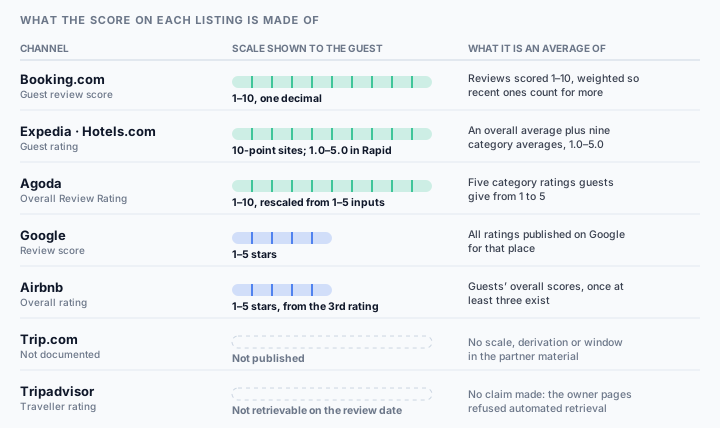
    Seven listing channels compared by the scale they display a guest review score on and what that score averages. Booking.com, Expedia Group and Agoda display out of ten; Google and Airbnb display out of five; Trip.com and Tripadvisor publish no retrievable explanation. Booking.com weights recent reviews more heavily, Expedia Group publishes an overall average plus nine category averages between 1.0 and 5.0, Agoda averages five category ratings given from 1 to 5, Google averages all ratings published on Google for the place, and Airbnb averages guests' overall scores once at least three exist.
    The two strip lengths are the point: a 1–5 scale is drawn at half the width of a 1–10 scale. Scroll horizontally on a narrow screen, or read the same mapping in the table below.
    Each listing channel, what it calls the score, the scale a guest reads, how the total is produced, and how long a review counts
    ChannelField nameScale shownHow the total is produced
    Booking.comBooking.comGuest review score1–10, with one decimal. Each individual review score is also between 1 and 10.Weighted towards recent reviews
    Expedia GroupExpedia, Hotels.com, VrboGuest ratingA 10-point scale on the Expedia, Hotels.com and Vrbo websites. Expedia Group’s Rapid content model publishes the same ratings on a 1.0–5.0 scale.Average of the ratings received
    AgodaAgodaOverall Review Rating1–10 on the property page, built from category ratings guests give on a 1–5 scale.Rescaled average of category ratings
    GoogleGoogle Search and Maps hotel resultsReview score (user ratings)1–5 stars, with 5 as the highest rating.Average of the ratings received
    AirbnbAirbnb listings, including hotel roomsOverall rating1–5 stars, shown only once at least three guests have rated the listing.Average of the ratings received
    Trip.comTrip.comNot documented in Trip.com’s public partner materialNot published.Not published
    TripadvisorTripadvisorTraveller rating (bubbles)Not claimed here.Not published

    Platform by platform

    One entry per channel: what the platform says the number is built from, who it lets review, how long a stay keeps counting, and which category ratings it documents.

    Booking.com

    Mechanic published

    Guest review score · Booking.com

    How the number is built
    Booking.com describes a weighted review system in which the more recent the review, the bigger its impact on the total. Its partner-facing Connectivity documentation describes the same field more plainly: the Property Scores API returns a review score that “refers to the average guest review score for a property”, with a maximum of 10. Those two descriptions are not identical, which is the most useful thing to know about this number — read it as a recency-weighted aggregate whose formula is not published, not as an arithmetic mean you can reconstruct.
    Who may review
    Only someone who booked through Booking.com. Its wording covers two cases: a guest who stayed, and a guest who arrived at the accommodation but did not actually stay.
    How long it counts
    A three-year rolling window with a submission deadline at the front of it. Booking.com states it may only accept reviews submitted within 3 months of checking out, and that it may stop showing reviews once they are 36 months old or if the accommodation changes ownership.
    Documented category ratings
    None published.Booking.com’s public property pages show category ratings beside the total, but no Booking.com document retrievable to an automated reader on the review date lists them or states whether they feed the overall score. The category list is therefore deliberately absent here rather than copied from a third-party blog.
    What this means for you
    Your Booking.com number is the one with a documented expiry: a poor quarter stops being shown after 36 months rather than being diluted by volume, and a guest who checked out four months ago can no longer be asked to review. It is also the number most often compared with Agoda’s, because both run 1–10 — and that comparison is the least safe of all, since Agoda publishes its arithmetic and Booking.com does not.

    We use a weighted review system, which means that the more recent the review, the bigger the impact on the total review score calculation.

    Documentation gap: partner.booking.com refused an automated request (HTTP 403) on 24 October 2026, so no partner-help wording, category list or minimum-review threshold is claimed. The weighting itself is described but never quantified in any retrievable document.

    How to audit a Booking.com listing

    Expedia Group

    Mechanic published

    Guest rating · Expedia, Hotels.com, Vrbo

    How the number is built
    Rapid’s guest-rating model publishes an overall rating “averaged from all guest reviews”, nine averaged category ratings, a count of all guest review ratings that exist for the property, and the percentage of guests who recommend staying there — every rating between 1.0 and 5.0. Expedia Group’s XAP static-data platform publishes the same underlying satisfaction data differently: one average score and review count per brand, on “the same scale as used by the corresponding website (10 point scale for Expedia, Hcom and Vrbo)”, so that a partner can pick the scale matching the site it sends travellers to.
    Who may review
    A traveller Expedia Group has verified as having booked with it. Expedia Group also states that travellers may receive a savings voucher when they submit a review — a solicitation mechanic none of the other platforms reviewed here publishes.
    How long it counts
    XAP’s property record states that all available reviews over a 2-year period have been included. That is an API inclusion window rather than a published display rule, so treat it as evidence about the data Expedia Group distributes, not as a statement that the website drops a review at 24 months.
    Documented category ratings
    Cleanliness · Service (the staff’s service) · Comfort (of the rooms) · Condition (of the property) · Location (how convenient it is) · Neighbourhood (how satisfying it is) · Quality (of the rooms) · Value (for the cost of the stay) · Amenities (provided by the property)Each of the nine is documented as its own average between 1.0 and 5.0. Expedia Group’s documentation does not state that the overall rating is computed from them, so treat the nine as a diagnostic breakdown rather than the formula behind the total.
    What this means for you
    Two things follow, and both surprise operators. First, Expedia and Hotels.com are fed by one Partner Central listing, but XAP returns a separate average and review count for each brand — so one content fix lands on both pages while the two scores stay independent of each other. Second, the same satisfaction data appears inside Expedia Group’s own documentation on two scales, which is the clearest possible demonstration that a number without its scale is not a measurement.

    The guestRating section represents the average score using the same scale as used by the corresponding website (10 point scale for Expedia, Hcom and Vrbo).

    How to audit an Expedia listing

    Agoda

    Mechanic published

    Overall Review Rating · Agoda

    How the number is built
    Agoda is the only platform reviewed here that publishes the arithmetic. Guests rate five categories on a scale of 1 to 5; Agoda calculates the average of those scores on a 1–10 scale and displays the result as the Overall Review Rating on the property page. Every point of an Agoda score is therefore traceable to a category, which is not true of any other number on this page.
    Who may review
    Real guests, after check-out. Agoda states that it only allows real guests to review a property after check-out, and that it emails them an invitation to submit a written review once they have checked out.
    How long it counts
    Not published. Agoda’s article does not say whether older reviews stop counting, are weighted by recency, or are included indefinitely, so the window is unknown rather than unlimited.
    Documented category ratings
    Value for money · Service · Facilities · Location · CleanlinessThese five are the inputs to the total, not a breakdown beside it. A category that slips therefore moves the headline number by construction.
    What this means for you
    Agoda and Booking.com share a scale and share almost nothing else. An 8.6 on Agoda is a rescaled average of five specific category ratings; an 8.6 on Booking.com is a recency-weighted aggregate whose relationship to its categories is not documented. If you only ever read one platform’s categories, read these — they are the only ones published as the cause of the total.

    Your Review Score is the aggregate rating that your property earns based on all the reviews that are left by your Agoda guests.

    How to audit an Agoda listing

    Google

    Mechanic published

    Review score (user ratings) · Google Search and Maps hotel results

    How the number is built
    Google states that the review score is the average of all ratings published on Google for that place or business, and that after someone leaves a new review it may take up to 2 weeks for the score to update. A hotel’s Business Profile may additionally show reviews from travel websites, which display the overall rating for the hotel and a link to the hotel’s page on that website.
    Who may review
    Google publishes no requirement that a reviewer booked or stayed. This is the single biggest difference in population between Google and the OTAs, three of which restrict reviewing to guests who booked through them.
    How long it counts
    Up to 2 weeks for a new review to be reflected in the score. No ageing rule is published, so nothing in the documentation reviewed limits how long a rating keeps counting.
    Documented category ratings
    None published.No category ratings. Google’s own feed formats treat the scale as something that has to be declared rather than assumed: in its vacation-rentals feed documentation a rating is “a floating point number representing the aggregate property rating”, “typically from 0-5, 0-10, or 0-100”, and a separate rating scale attribute gives the maximum rating possible, defaulting to 0-10 when it is left out.
    What this means for you
    Google is where your other platforms’ numbers meet, and the one surface where you do not choose the mix: it states plainly that you cannot choose which website a review comes from, and for a hotel outside the European Economic Area it directs you to contact that provider rather than Google. So a score you are unhappy with on an OTA is not contained to that OTA’s page.

    The review score is the average of all ratings published on Google for that place or business.

    How to audit a Google hotel listing

    Airbnb

    Mechanic published

    Overall rating · Airbnb listings, including hotel rooms

    How the number is built
    Airbnb publishes a display floor rather than a formula: once at least 3 guests rate a home, the average of their overall rating scores is shown near the listing title in search results and on the listing itself. Guests rate an overall score plus six named categories.
    Who may review
    Not stated in the article reviewed. It describes what guests rate and when an average appears, not who is eligible to rate, so no eligibility claim is made here.
    How long it counts
    Not stated in the article reviewed.
    Documented category ratings
    Cleanliness · Accuracy · Check-in · Communication · Location · ValueAlongside the overall rating. Accuracy is the one category in any model reviewed here that names the listing itself as the thing being rated, which is why it is the closest point of contact between a content audit and a review score — and still not evidence that one moves the other.
    What this means for you
    The three-rating floor is the only published display threshold among the platforms reviewed, and it explains a pattern operators misread constantly: a new Airbnb listing shows no rating at all while the same property’s Booking.com page shows a three-year average. A missing number is not a bad number.

    Once at least 3 guests rate your home, the average of their overall rating scores is shown near the home’s title in search results and on the listing.

    How to audit an Airbnb hotel listing

    Trip.com

    Nothing published

    Not documented in Trip.com’s public partner material · Trip.com

    How the number is built
    Not published.
    Who may review
    Partially addressed. Trip.com states that its review validation team works to ensure that all guest reviews are authentic and posted by real Trip.com users, which speaks to authenticity rather than to booking or stay eligibility.
    How long it counts
    Not published.
    Documented category ratings
    None published.None published in the partner material reviewed.
    What this means for you
    Treat the Trip.com number as an observation you log, not a metric you can explain. Record what the public page displays today with the date, so a change is visible later, and ask Trip.com support in writing for the scale and the window — then keep the reply.

    Documentation gap: Trip.com’s public partner FAQ covers the listing process, content management, pricing and commission, and says nothing about the scale, derivation, categories or ageing of a review score. This entry records the gap rather than assuming Trip.com behaves like Booking.com or Agoda because it also shows a number out of 10.

    How to audit a Trip.com listing

    Tripadvisor

    Nothing published

    Traveller rating (bubbles) · Tripadvisor

    How the number is built
    Not claimed here.
    Who may review
    Not claimed here.
    How long it counts
    Not claimed here.
    Documented category ratings
    None published.None claimed here. The owner-facing pages that would document them were not retrievable on the review date.
    What this means for you
    The honest instruction is to read Tripadvisor’s own current explanation in a browser, where it is reachable, and to distrust any article — including a confident one — that states the weighting. If you log the bubble rating in your own record, log the date beside it and nothing else.

    Documentation gap: www.tripadvisor.com refused automated retrieval with HTTP 403 on 24 October 2026, including the hotel-owner resources that explain its rating and its Popularity Ranking. Second-hand explanations of both circulate very widely and none of them is Tripadvisor, so this page makes no claim about either. Tripadvisor is included as a row precisely because an operator comparing numbers will have its bubbles in front of them.

    How to audit a Tripadvisor hotel listing

    Why your scores disagree, and why there is no conversion

    Eight mechanisms, in rough order of how often they explain a gap. None of them is a defect on your listing, which is why the first job is reading the numbers correctly rather than chasing them.

    1. Halving or doubling is not a conversion

      Expedia Group publishes the same satisfaction data on a 1.0–5.0 scale in one of its APIs and on a 10-point scale in another, explicitly so a partner can match the website it sends travellers to. That is a within-company rescaling of one dataset. No platform publishes a mapping between its score and another platform’s, so turning a 9.0 into a 4.5 to compare it with Google is arithmetic performed on two unrelated instruments.

    2. The same scale, two different instruments

      Agoda’s 1–10 is the average of five category ratings guests gave between 1 and 5. Booking.com’s 1–10 is a recency-weighted aggregate of scores between 1 and 10, with no published relationship to its categories. Equal numbers on those two channels do not describe equal performance, and the difference between them is not an error either.

    3. Different populations

      Google publishes no requirement that a reviewer booked or stayed, while Booking.com, Expedia Group and Agoda all restrict reviewing to guests who booked through them. A property whose Google average sits below its OTA scores may simply be averaging a different set of people — including, on a hotel Business Profile, ratings carried in from travel websites.

    4. Different clocks

      A three-year display window with a three-month submission deadline, a two-year inclusion window in a data feed, and an average with no published expiry will not move at the same speed after the same refurbishment. Reading them as one trend line produces a story about your hotel that none of the three platforms is telling.

    5. One listing, two scores

      Expedia and Hotels.com are fed by a single Partner Central listing, which is why their factual content should agree — but XAP returns a separate average and review count per brand. Operators who have correctly learned that the content is shared often expect the scores to be shared too.

    6. Your score turns up where you did not put it

      A hotel’s Google Business Profile may show reviews from travel websites, with the overall rating for the hotel and a link through to that site. Google states you cannot choose which website a review comes from, and outside the European Economic Area it directs a hotel with a problem to the provider rather than to Google. An OTA score is therefore not contained to that OTA’s page.

    7. A missing score is not a low score

      Airbnb shows no average until at least three guests have rated, and Google’s third-party review feed documentation states that any listing or review without a rating, and listings with no valid reviews, will not be shown. A blank is frequently read as a bad number by whoever is compiling the monthly report.

    8. The weighting is never published

      Where a platform describes its calculation as weighted, it does not say by how much. Nothing on this page reconstructs a formula, and any article that gives you one for Booking.com or Tripadvisor is telling you something its publisher could not have read in the documentation either.

    Recording the scores so the comparison is honest

    Six steps. The first one does most of the work: capture the qualifiers at the same moment as the number, and the monthly argument about which channel is lying stops happening.

    1. Record the number with its three qualifiers

      Scale, population and date, in the same row as the score. “8.6” is not data; “8.6 out of 10, Booking.com, guests who booked through the platform, read on 24 October” is. Half the confusion this page exists to resolve disappears at the point of capture.

    2. Read the categories where they are published

      Agoda’s five are the inputs to its total, so they explain movement by construction. Expedia Group’s nine are documented averages that let you separate a location complaint from a cleanliness one. Booking.com’s categories are visible on the page but undocumented, so note them as observations rather than causes.

    3. Open Expedia and Hotels.com as two separate records

      One Partner Central listing, two public pages, two independent review pools. If your register has a single Expedia Group row, it is hiding the difference you most want to see.

    4. Check what Google is repeating about you

      Look at the hotel Business Profile as a traveller and note both the Google average out of 5 and any travel-website ratings shown beside it with a link. You cannot choose those sources, so the only useful response is to know which ones are in front of your guests.

    5. Watch the clock, not just the average

      On Booking.com a stay stops being reviewable three months after check-out and stops being shown after 36 months, so a recovery plan has a documented horizon on that channel and an undocumented one elsewhere. Note the window beside each score; it is what makes a comparison across months defensible.

    6. Keep the content audit and the reputation programme separate

      Fixing a wrong breakfast price and raising a review score are two projects. They touch — Airbnb publishes an Accuracy category that rates the listing itself — but no source cited here establishes that one causes the other, so do not report them as one number or promise a board that the second follows the first.

    The numbers you do control

    A review score is produced by your guests on somebody else’s scale. Your breakfast price, parking charge, arrival times, cancellation terms and fees are not — and those are the facts a guest checks before booking. A free check reads your live Booking.com, Expedia, Hotels.com, Trip.com and Agoda listings and shows where they disagree, quoting the source text for each field.

    Run a free consistency scan

    No login, public pages only. See a sample report or which fields the comparison covers.

    Working the scores into a wider review? Replying to the reviews behind them is its own job — how to handle negative hotel reviews covers the published response mechanics on each platform. The other number guests mistake for this one is the star rating, and hotel star ratings across OTAs records who assigns it. Route an edit with the hotel OTA extranet directory, sweep the comparable fields with the OTA content audit checklist, and see which sources an AI assistant can read about your hotel if you want to know where a score gets repeated next.

    What this page is not

    • Not a reputation-management guide. How to answer a review, and who should sign the reply, is a separate job — the guide on handling negative hotel reviews covers it.
    • Not a ranking or conversion guide. Nothing here claims that a score changes position, visibility or booking rates on any platform, and no uplift figure appears on this page.
    • Not a formula. Where a platform describes its calculation as weighted, it does not publish the weights, and this page does not reconstruct them from examples or from third-party articles.
    • Not a review-generation playbook. Soliciting reviews is governed by each platform's own rules and, in several markets, by consumer-protection law; this page records only what the platforms publish about how an existing score is built.
    • Not a star-rating page. Star ratings are a facilities classification with a different owner and a different correction route, and they are covered separately.
    • Not a complete list of platforms. Hostelworld, HRS and regional channels also publish scores; they are absent because no retrievable partner documentation of their scoring was found on the review date.

    Scanner scope: A MisMatchMaker scan does not read or compare guest review scores. It compares 24 factual listing fields — breakfast, pets, parking, arrival and departure times, cancellation terms, Wi-Fi, children, taxes and fees, and a short amenity list — across your public Booking.com, Expedia, Hotels.com, Trip.com and Agoda pages. Review scores are generated by each platform from its own guests, on its own scale, over its own window, so two channels showing different numbers is the expected output rather than a mismatch to fix. Use this page as the manual read that sits beside an automated content scan, and keep the two programmes separate: no source cited here supports a claim that correcting a listing field raises a score.

    Frequently asked questions

    Why is my hotel's review score different on Booking.com and Expedia?
    Because the two numbers are different measurements of different populations on different scales. Booking.com scores each review between 1 and 10 and describes a weighted system in which the more recent the review, the bigger its impact on the total. Expedia Group publishes an overall rating averaged from all guest reviews — on a 10-point scale on its websites, and between 1.0 and 5.0 in its Rapid content model — restricted to travellers it has verified as having booked with it. Neither number is derived from the other, so a gap between them is the expected result rather than evidence that one listing is wrong.
    Is a 9.0 on Expedia the same as a 4.5 on Google?
    No, and halving or doubling does not convert between platforms. Expedia Group does publish the same satisfaction data on two scales — a 10-point scale matching its websites and a 1.0 to 5.0 range in its Rapid model — but that is one company rescaling one dataset so partners can match the site they send travellers to. Google's score is the average of all ratings published on Google for that place, from reviewers with no published requirement to have booked or stayed. Two averages over different populations are not interchangeable at any scale.
    How is the Booking.com guest review score calculated?
    Booking.com publishes the mechanic but not the formula. Each review score is between 1 and 10, and it states that it uses a weighted review system in which the more recent the review, the bigger the impact on the total review score calculation. Its partner-facing Property Scores API describes the same field as the average guest review score for a property, with a maximum of 10. Reviews may only be accepted within 3 months of checking out, and Booking.com says it may stop showing reviews once they are 36 months old or if the accommodation changes ownership. The weighting is never quantified in any document retrievable to us, so treat any article that gives you the formula as unsourced.
    How is the Agoda review score calculated?
    Agoda is the only platform reviewed here that publishes the arithmetic. Guests rate five categories — Value for money, Service, Facilities, Location and Cleanliness — on a scale of 1 to 5. Agoda calculates the average of those scores on a 1 to 10 scale and displays the result as the Overall Review Rating on the property page. It also states that only real guests may review, after check-out, and that it emails them an invitation once they have checked out. Because the five categories are the inputs rather than a breakdown beside the total, a category that slips moves the headline number by construction.
    How long do hotel reviews count towards the score?
    It depends entirely on the platform, and two of them do not say. Booking.com states it may only accept reviews submitted within 3 months of checking out and may stop showing them once they are 36 months old or the property changes ownership. Expedia Group's XAP property record states that all available reviews over a 2-year period are included, which is an API inclusion window rather than a published display rule. Google says a new review may take up to 2 weeks to be reflected in the score and publishes no ageing rule at all. Agoda, Airbnb, Trip.com and Tripadvisor publish nothing retrievable on this in the sources reviewed.
    Who is allowed to leave a review on a hotel listing?
    The populations differ, and this is the difference that matters most. Booking.com allows a review from someone who booked through the platform and either stayed or arrived without staying. Expedia Group verifies that the traveller booked with Expedia Group, and states travellers may receive a savings voucher when they submit a review. Agoda allows real guests to review after check-out. Google publishes no requirement that a reviewer booked or stayed. Airbnb's ratings article does not state the eligibility rule, so no claim is made here.
    Why does my Booking.com score show up on my Google listing?
    Because Google may show reviews from travel websites on a hotel's Business Profile, displaying the overall rating for the hotel and a link to the hotel's page on that website. Google states that you cannot choose which website a review comes from. For a hotel outside the European Economic Area, Google's guidance is to find the third-party reviewer's name and contact that provider through their website rather than flagging the review on Google. The practical consequence is that an OTA score is not contained to that OTA's page.
    How is the Tripadvisor bubble rating calculated?
    This page does not say, on purpose. Tripadvisor's own site refused automated retrieval with an HTTP 403 response on 24 October 2026, including the hotel-owner resources that explain its rating and its Popularity Ranking, so there was no primary text to quote. Second-hand explanations of both circulate very widely and are often stated with more confidence than their sourcing supports. Read Tripadvisor's current explanation in a browser, where it is reachable, and distrust any article that hands you the weighting.
    Does MisMatchMaker check review scores?
    No. A scan compares 24 factual listing fields — breakfast, pets, parking, arrival and departure times, cancellation terms, Wi-Fi, children, taxes and fees, and a short amenity list — across your public Booking.com, Expedia, Hotels.com, Trip.com and Agoda pages, quoting the source text for each. Review scores are generated by each platform from its own guests on its own scale, so two channels showing different numbers is the expected output rather than a mismatch to fix. Nothing on this page claims that correcting listing content raises a score; no reviewed source supports that.
    Sources

    Platform documentation and developer references, each opened and checked on the date shown. Where a page refused automated retrieval, it is listed with that outcome rather than cited for a claim. Platform help centres change wording without notice, so the linked page is always the authority.

    1. How we work: reviews and review scores — Booking.com, accessed
    2. Property Scores API: property scores — Booking.com for Developers (Connectivity), accessed
    3. Rapid SDK reference: GuestRating model — Expedia Group Open Source, accessed
    4. Static data platform: guest ratings and reviews — Expedia Group Developer Hub (XAP), accessed
    5. Rapid lodging: verified guest reviews — Expedia Group Developer Hub, accessed
    6. How review scores work — Agoda Partner Hub, accessed
    7. Scoring ratings for local places — Google Business Profile Help, accessed
    8. Reviews from other websites on a hotel's Business Profile — Google Business Profile Help, accessed
    9. How to send third-party reviews to Google — Google Hotel Center Help, accessed
    10. Vacation rentals feed attributes: review, rating and rating scale — Google Hotels for Developers, accessed
    11. Ratings for homes — Airbnb Help Centre, accessed
    12. List your property: partner FAQs — Trip.com, accessed
    13. Hotel owner resources (automated retrieval refused with HTTP 403 on the review date) — Tripadvisor, accessed

    Each claim above is recorded in the source index with its supported wording and limitations, on the editorial standards this site holds itself to: wording narrowed to what the source supports, gaps left visible, and nothing inferred presented as documented.