- Is there a standard definition of an accessible hotel room across OTAs?
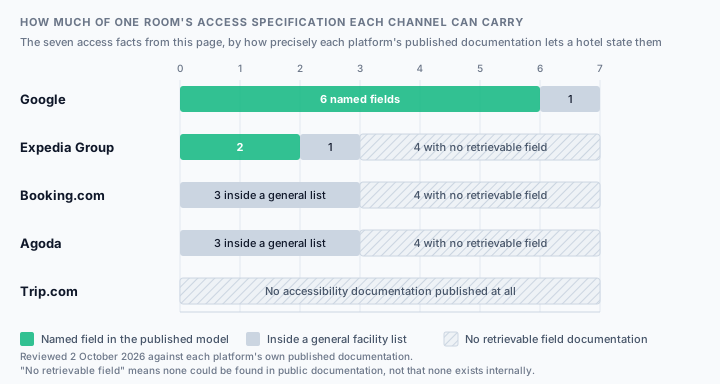
- No. There is no shared definition and no shared field set. Google's lodging schema carries about a dozen named accessibility fields, including separate ones for an accessible shower, an accessible bathtub and an accessible toilet; Expedia Group's content reference lists name a general accessibility amenity plus accessible parking and an accessible wheelchair; Booking.com models access as an entry in a general facility list whose only documented attributes are whether it is paid and whether it is off-site; Agoda's published facilities guidance names no accessibility group at all; and Trip.com publishes nothing retrievable. Booking.com's own traveller article puts it most plainly: the meaning of accessible can vary from hotel to hotel.
- What accessibility fields does Google's hotel data model include?
- More than any other model reviewed here. At property level it names a mobility-accessible property, accessible parking, an accessible lift, an accessible pool and wheelchair rental, with notably concrete definitions — accessible parking is a marked, designated area of prescribed size for registered, labelled vehicles, and an accessible pool is one with a mechanical chair that can be lowered and raised. A separate living-area accessibility section covers the room itself: a mobility-accessible unit, an ADA-compliant unit, a hearing-accessible unit, a hearing-accessible doorbell, a hearing-accessible fire alarm, and distinct fields for an accessible shower, bathtub and toilet. What it still does not carry is a single measurement: no clear door width, no turning circle and no grab-bar field.
- Do OTAs have to describe accessible hotel rooms accurately?
- The obligation mostly runs to the hotel, and the standard is higher than a tick box. The US ADA reservations rule requires a place of lodging to identify and describe accessible features in enough detail to reasonably permit a disabled traveller to assess independently whether the room meets their needs, and it applies to reservations made by any means, including through a third party. In the EU, the European Accessibility Act brought e-commerce into scope from June 2025, and Booking.com's own accessibility statement — published in June 2025 — says it covers the portions of its services in scope while directing questions about wheelchair access or walk-in baths at a particular stay to the provider of that stay. The platform answers for the interface; the hotel answers for the facts. This is a summary of the standards, not legal advice.
- Why does my hotel show as wheelchair accessible on one OTA and not another?
- Usually because the channels have different numbers of fields and the information was poured into containers of different sizes. The same roll-in shower is a named field on one model, a general amenity identifier on another, an undifferentiated facility tick on a third and unpublishable on a fourth. On top of that, the level matters: declaring access at property level when only one room is adapted tells every guest the building is accessible, and declaring it only at room level can keep you out of a property-level filter entirely. Publication lag is the third cause — Agoda's guidance states facility changes can take up to six hours to appear — so a correction made this morning is not necessarily what today's guest reads.
- How do I list a wheelchair accessible room on Booking.com?
- Access is one of the facilities you tick for the property, and the public listing then exposes it to the wheelchair-accessible filter Booking.com describes in its own traveller article. Two honest caveats. First, the facility identifiers are not published as a reference document — Booking.com's developer documentation points integrators at a constants endpoint to retrieve the names and identifiers in use — so the authoritative list of what you can tick is the one in your own Extranet, and partner.booking.com refused automated retrieval on the review date, so no click path is claimed here. Second, the tick is not a description: the documented facility model carries only whether a facility is paid and whether it is off-site, so the shower type, the door width and the alarms have to go into your free-text room and property descriptions.
- Can a channel manager sync accessibility information across OTAs?
- Not faithfully, and the reason is structural rather than a shortcoming of any particular tool. Channel managers are built to distribute rates and availability; descriptive content is handled unevenly, and in this case there is no shared model to map onto. A field that exists on one channel has no counterpart on another, so a sync has to either drop the detail or invent a destination for it. There is no lossless translation between thirteen named fields and a single facility tick, which is why the practical answer is a written specification you own, pushed manually into whatever each channel can carry, plus free text for the rest.
- Does MisMatchMaker check accessibility information across OTAs?
- No, and it would be wrong to imply otherwise. A scan compares breakfast, pets, parking, Wi-Fi, arrival and departure times, cancellation terms, fees and a short list of general amenities across your public Booking.com, Expedia, Hotels.com, Trip.com and Agoda pages, quoting the source text for each. Accessibility is not among those fields, partly because most channels do not publish them in a form two listings can be compared on, and partly because a wrong answer here is worse than no answer. Two adjacent fields are compared and worth watching: parking, where a disagreement is worth reading closely even though a scan cannot tell you whether either listing promises an accessible bay, and the pet policy, where an assistance-animal problem will surface.
- What should I write in the free-text description about access?
- Numbers and nouns, not adjectives. The standard to aim at is the one the ADA reservations rule sets: enough detail for a guest to assess the room independently, without calling you. In practice that means the narrowest clear door opening in centimetres, the bathroom transfer type in plain words, where the grab rails are fitted, the bed height, whether the fire alarm is audible only, and what the route from the pavement to the room actually involves — including the bad news, because a guest who finds a step you did not mention will not book with you again, and one who reads about it and books anyway has made an informed choice.