- What age counts as a child on Booking.com?
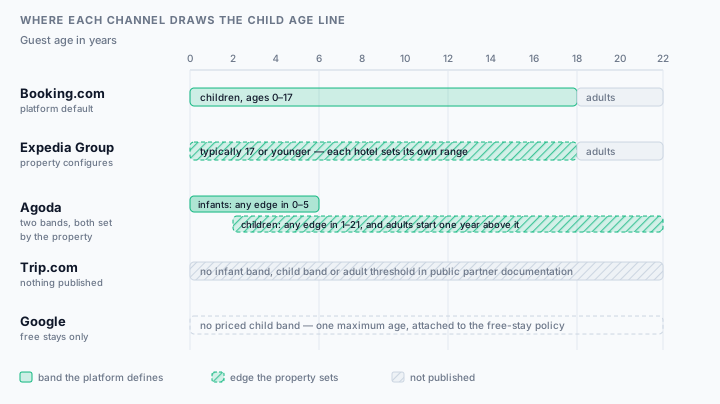
- Booking.com's published child-policy documentation states that by default it treats ages 0–17 as children, and that properties can define their own minimum age. The default is the platform's, the narrowing is yours, and the age range is the input to whichever child rate you have configured — so a band edge you never reviewed is still the one pricing your family bookings.
- What age is a child on Expedia and Hotels.com?
- Expedia Group states that individuals aged 17 or younger are typically considered children, that each hotel configures what age range it classifies as a child, and that some properties do not allow guests under 18 at all. It also requires that the age of each child traveller can be specified at booking, so the ages arrive with the search rather than being inferred from a published band.
- Does Agoda treat infants differently from children?
- Yes. Agoda's partner documentation describes a separate infant band that can be set between 0 and 5 years old and a child band that can be set between 1 and 21, with guests older than the maximum child age counted as adults. Both are defined at property level first and then applied to room types, so the property-level edit is the one that reaches every room.
- Do children who stay free still count towards maximum occupancy?
- It depends on the platform, and Agoda documents it as an explicit switch. With occupancy control on, the adults, children and infants a room takes — including the children allowed free — are limited to the guests allowed in the room plus the extra beds. With it off, maximum occupancy becomes the guests allowed plus the extra beds plus the children allowed free. Booking.com constrains it differently, capping children at the total number of guests minus one so that an adult is always present.
- Why do my OTA listings quote different prices for the same family?
- Usually because the same intent has been encoded in models that do not match. The band edges were entered platform by platform, one channel counts a free child inside occupancy while another adds it on top, child rates on Booking.com cover existing beds but not cots or extra beds, and a per-night basis on one channel meets a per-stay basis on another. Each configuration can be individually valid and still produce a different bill.
- Can a channel manager keep child policies in sync across OTAs?
- Not reliably, and not in the way most operators assume. Channel managers are built to distribute rates and availability; descriptive and policy content is handled unevenly, and the platforms do not share a single child-policy model to map onto. Because the age bands, occupancy arithmetic and bedding rules differ by platform, there is often no faithful one-to-one translation to push — which is why the family search test is a manual check rather than a report you can pull.
- Does MisMatchMaker check child policies across OTAs?
- It checks two of the five facts. A scan compares whether children are welcome at all and the extra bed or cot fee across your public Booking.com, Expedia, Hotels.com, Trip.com and Agoda pages, quoting the source text for each. It does not compare age bands, free-child allowances or occupancy limits, because a listing page usually does not state them — those need the priced family search described on this page.