Reference

    Hotel star ratings across OTAs: who assigns them, and why yours disagree

    The star rating is the most prominent number on your listing and usually the one you control least. One channel repeats whatever your property declared, another assigns its own value where no authority publishes one, and Google infers a class from attributes that include your price. This page records who sets each number, using each platform's own documentation, and what actually moves it.

    Every policy, quotation and scheme detail below was checked against primary sources on . Where a platform publishes nothing retrievable, the entry says so instead of guessing.

    The short answer

    No single party owns your star rating. Booking.com states it does not assign star ratings at all — depending on local regulations they come from the property itself or from an independent third-party rater — and that it does not review them unless it learns one is wrong. Expedia Group publishes the official rating in the regions where a local authority designates one and assigns its own value everywhere else. Agoda verifies the rating you claim against an official certificate or its own signed checklist. Trip.com publishes no star-rating policy at all. Google does not show a star rating: it shows a class rating it derives itself, partly by machine-learning inference over attributes including price. Different assigners, different scales and different clocks are why one hotel legitimately shows different numbers.

    What most operators get wrong

    • Assuming a star rating is a fact. On several channels it is a claim the platform repeats — and Booking.com says it does not impose its own standards or review the rating.
    • Treating a difference as a defect. Because the assigners differ, a hotel can show four stars on one channel and a four-star class on another that was inferred, not awarded. Only one of those can be corrected with a certificate.
    • Reading the review score as stars. Booking.com's 1–10 score is guest satisfaction, weighted towards recent reviews. It is not a half-star version of the yellow stars beside it.
    • Forgetting that classifications expire. A certificate with a lapsed date still shows on your listings until somebody notices, and renewal is a scheduled job, not a support ticket.
    • Trying to edit a value nobody gave you. Google's class rating has no certificate step — the documented route is feedback to Google, and the attributes it reads include your price.

    Three different numbers get called a rating

    Before comparing channels, separate the three things a traveller sees. They have different owners, different inputs and different correction routes, and conflating them is what sends a fixable problem to the wrong place.

    Official classification, platform-assigned rating and guest review score compared by who sets them, what they measure, when they change, and what evidence exists
    RatingSet byWhat it measuresChanges whenEvidence you can hold
    Official classificationA national or regional classification body, or an independent scheme it recognisesVerified presence of defined facilities and services, checked against a published criteria catalogue, usually during an on-site auditThe hotel is re-audited, or the classification lapses and is not renewedA certificate with a reference number and an expiry date
    Platform-assigned star or class ratingThe OTA or search platform, where no official rating is available to repeatThe platform's own read of the property — for Google, attributes including price, location, room size and amenitiesThe platform re-evaluates, or the attributes it reads changeNone a hotel holds; the platform's support channel is the only route
    Guest review scoreGuests who booked and stayedSatisfaction with the stay, not the facility level of the buildingContinuously, as reviews arriveThe platform's own aggregate — on Booking.com a 1–10 score, weighted so a more recent review has more impact on the total

    Booking.com describes its own display directly: 1–5 yellow stars beside the property name, assigned by the property or a third party, and a separate 1–10 review score from guests, weighted so a more recent review has more impact on the total.

    Where each channel's rating comes from

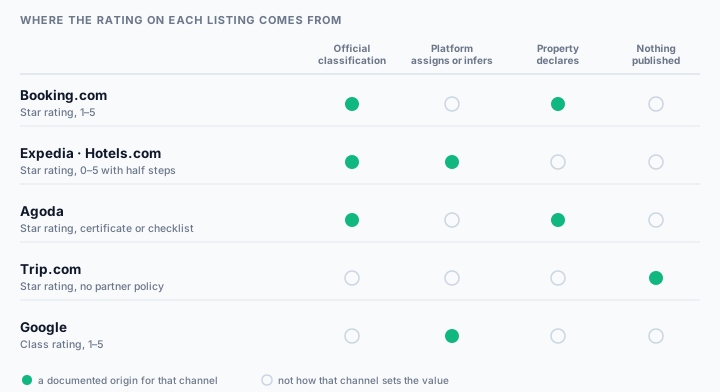
    Read each row as one channel and ask a single question: could a certificate change this number? Where the answer is no, the value is the platform's, and your lever is a support conversation rather than an edit.

    Matrix of five hotel listing channels against four rating origins. Booking.com: official classification or the property's own declaration. Expedia and Hotels.com: official classification where a local authority designates one, otherwise assigned by Expedia. Agoda: official certificate, or the property's declaration verified against Agoda's checklist. Trip.com: nothing published. Google: assigned by Google and partly inferred.
    Four possible origins, five channels. Scroll horizontally on a narrow screen, or read the same mapping in the table below.
    Each listing channel, the field name it uses, its scale, and who assigns the value
    ChannelField nameScaleAssigned by
    Booking.comBooking.comStar rating1–5 yellow stars beside the property nameProperty or a third party
    Expedia GroupExpedia, Hotels.comStar rating0–5 in half-star steps (1.5, 2.5, 3.5, 4.5 are all valid); 0 or blank means no rating is availablePlatform or local authority
    AgodaAgodaStar ratingWhole stars, entered on the YCS property settings pageProperty or a third party
    Trip.comTrip.comStar ratingNot documented in Trip.com's public partner materialNot published
    GoogleGoogle Search and Maps hotel resultsClass rating (not a star rating)1–5 stars, used as a search filter; hotels with no class rating have not yet been evaluatedPlatform, partly inferred

    The four origins the diagram distinguishes are: official rating, where one exists; declared by the property; inferred by the platform; not documented.

    Platform by platform

    One entry per channel: who sets the number, what the platform says it does to check it, and the documented route to a correction.

    Booking.com

    Policy published

    Star rating · Booking.com

    Who assigns it
    Not Booking.com. It states that star ratings are assigned either by the properties themselves or by independent third parties, depending on local regulations.
    What the platform checks
    None as a matter of course. Booking.com says it neither imposes its own standards for star ratings nor reviews them, and only intervenes once it becomes aware that a rating is inaccurate — at which point it asks the property to prove the rating or adjust it.
    How a correction is made
    Booking.com publishes no openly retrievable partner article on changing a star rating; its partner help centre refused an automated request on the review date. Expect to raise it with partner support and to produce the classification evidence its policy implies.
    What this means for you
    On Booking.com the star rating is closer to a claim than a verdict. If nobody at the property can name the body that awarded it, it is a self-declaration — and since 2018 that has been the subject of Dutch advertising decisions.

    We don't assign star ratings. Depending on local regulations, they're assigned either by the Service Providers themselves or by independent third parties (e.g. organisations that rate hotels).

    Documentation gap: partner.booking.com returned an access error to our automated reviewer on 30 September 2026, so no Extranet field path is recorded here.

    How to audit a Booking.com listing

    Expedia Group

    Policy published

    Star rating · Expedia, Hotels.com

    Who assigns it
    Either Expedia Group or a local star rating organisation. Its content reference names France, Italy, Turkey, the United Arab Emirates and Israel as regions where official ratings are designated by local authorities; a rating shown for a property in another region is an Expedia-assigned rating.
    What the platform checks
    The data model itself records the provenance: a property rating typed as star is the official rating from the local authority, while alternate marks a rating Expedia assigned because no official one is available.
    How a correction is made
    Where an official authority exists, the authority's decision is the lever — the platform is repeating it. Where the value is Expedia-assigned, it is a Partner Central support question, not a field a hotel edits.
    What this means for you
    Expedia and Hotels.com are fed by one Partner Central listing, so they should not disagree with each other. A half-star is a useful tell: it cannot have come from a European classification scheme that awards whole star levels, so it is a platform-assigned value.

    A value assigned either by Expedia Group or by a local star rating organization.

    How to audit an Expedia listing

    Agoda

    Policy published

    Star rating · Agoda

    Who assigns it
    The property proposes it and Agoda verifies it. A new partner sets a star rating at registration, which Agoda verifies as part of registration.
    What the platform checks
    Documented and evidence-based. An existing partner has to attach either an official star rating certificate from a hotel rating organisation or government, or a signed Agoda Star Rating Checklist, to a request raised through the Need Help button in the partner portal. Agoda states that it does not guarantee the request will be granted or the result of the verification process.
    How a correction is made
    Raise a request through Need Help in the partner portal with the certificate or the signed checklist attached. Where no official certificate exists, Agoda says it will review the property against the checklist provided.
    What this means for you
    Agoda is the clearest case for keeping a paper trail. The same certificate that supports an Agoda request is what you want on file for every other channel.

    If you are not able to provide an official star rating certification, Agoda will review your property based on the star rating checklist provided.

    How to audit an Agoda listing

    Trip.com

    No published policy

    Star rating · Trip.com

    Who assigns it
    Not published. Trip.com's public partner FAQs cover listing and content management but do not address how a star rating is set or changed.
    What the platform checks
    Not published.
    How a correction is made
    Trip.com states that once a property is live, partners can update their details in eBooking at any time. Because the star rating specifically is undocumented, treat it as a support request and ask what evidence eBooking needs.
    What this means for you
    An undocumented field is not a field you can assume is correct. Record what Trip.com displays today so a future change is visible, and get the answer from support in writing.

    Documentation gap: Trip.com publishes no retrievable partner policy for star ratings. This entry deliberately records the gap rather than assuming Trip.com behaves like Booking.com or Agoda.

    Google

    Policy published

    Class rating (not a star rating) · Google Search and Maps hotel results

    Who assigns it
    Google. It gathers data for class ratings from third-party partners, its own research, feedback from hoteliers, and machine-learning inference over hotel attributes such as price, location, room size and amenities.
    What the platform checks
    No certificate step is published. Google invites hoteliers with a question or feedback about their property's class rating to contact it.
    How a correction is made
    Contact Google with feedback on the class rating. Amenities are separately editable in the Business Profile dashboard, and Google's hotel descriptions are written by its own team of writers rather than submitted by the hotel.
    What this means for you
    Google's class is the one value your own pricing can move, because price is named as an input. A repositioning, a long discounting run, or a change in room mix can shift the class Google displays without anybody at the hotel editing a field.

    Google gathers data for class ratings from a variety of sources, including third-party partners, direct research, feedback from hoteliers, and machine learning inference that examines and evaluates hotel attributes, such as price, location, room size, and amenities.

    How to audit a Google hotel listing

    Why one hotel shows different stars on different channels

    Seven mechanisms, in rough order of how often they explain a difference. Most of them are not errors, which is why the first job is diagnosis rather than a round of support tickets.

    1. Different parties assign it

      Booking.com repeats what the property or a third party declared. Expedia repeats an official rating where one exists and assigns its own where it does not. Google infers a class. Three mechanisms cannot be expected to agree.

    2. Different scales

      Expedia's content model accepts half-stars; a classification scheme that awards whole star levels cannot produce a 3.5. A half-star on a listing is therefore a platform value, not a classification.

    3. Different inputs

      Google names price among the attributes it evaluates, so a sustained rate change or a repositioning can move the class Google shows while every field a hotel controls stays exactly as it was.

    4. Different clocks

      Classifications expire. In France renewal is requested every five years, and Hotelstars Union classifications are valid for a limited period. A listing can keep displaying a rating the certificate no longer supports.

    5. Different evidence thresholds

      Agoda asks for a certificate or a signed checklist before it changes a rating. Booking.com says it does not review star ratings at all unless it becomes aware one is inaccurate. The same property can pass one bar and never be asked to clear the other.

    6. A declaration nobody revisited

      Star ratings are usually entered once, during onboarding, often by whoever set the listing up. Renovations, downgrades, a lapsed classification and staff turnover all happen after that form was submitted.

    7. The review score gets mistaken for stars

      Booking.com's 1–10 review score sits next to the 1–5 stars and measures something else entirely: guest satisfaction, weighted so recent reviews count for more. An 8.9 is not four and a half stars.

    Where an official classification exists

    Whether a certificate can settle the question depends on your market. This is not a directory of every national scheme — it records the ones the platforms and classification bodies themselves document, and links to the awarding body rather than paraphrasing its criteria.

    20 European and neighbouring countries

    Hotelstars Union

    Participation
    A harmonised scheme operated by national member organisations
    Renewal
    Each classification is valid for a limited period, so hotels are reviewed regularly

    Austria, Azerbaijan, Belgium, Czech Republic, Denmark, Estonia, Georgia, Germany, Greece, Hungary, Latvia, Liechtenstein, Lithuania, Luxembourg, Malta, Netherlands, Poland, Slovenia, Sweden and Switzerland are listed as members. On-site audits cover 239 criteria, and the responsible classification society carries out a preliminary web-based evaluation before the inspection.

    Sources:Hotelstars Union — Our scheme: criteria and member countriesHotelstars Union — Frequently asked questions

    France

    Atout France hotel classification

    Participation
    Voluntary — the hotel applies
    Renewal
    Renewal must be requested every five years

    The hotel arranges an inspection of the property by a control body accredited by COFRAC. The current criteria took effect on 1 April 2022. Expedia Group separately names France as a region where official ratings are designated by local authorities.

    Sources:Atout France — Étoiles, le classement des hôtels évolueExpedia Group Developer Hub — Star ratings (Rapid lodging content reference)

    Italy, Turkey, United Arab Emirates, Israel

    Local authority designation

    Participation
    Named by Expedia Group as official-rating markets
    Renewal
    Set by the local authority

    Expedia Group's content documentation lists these regions, alongside France, as places where the star rating it publishes is the one designated by the property's local star rating authority rather than a value Expedia assigned. This page does not restate each national scheme's own rules, which the relevant authority publishes.

    Sources:Expedia Group Developer Hub — Star ratings (Rapid lodging content reference)

    Netherlands

    Voluntary classification, with an advertising-law history

    Participation
    Listed as a Hotelstars Union member country
    Renewal
    Set by the classifying body

    In dossier 2018/00684 the Dutch Advertising Code Commission held that Booking.com's display of hotel stars was misleading, and therefore unfair under Article 7 of the Dutch Advertising Code, where the stars had not been awarded by an independent classification body and no explanation of that was given.

    Sources:Hotelstars Union — Our scheme: criteria and member countriesStichting Reclame Code — Decision, dossier 2018/00684 (Booking.com, 6 December 2018)

    Markets with no authority to repeat

    Platform-assigned values

    Participation
    Not a choice the hotel makes
    Renewal
    Whenever the platform re-evaluates

    Where no official rating is available, Expedia Group states that the rating shown is Expedia-assigned, and Google states that it may infer a class rating from attributes including price, location, room size and amenities. Two platforms reading the same property independently have no reason to land on the same number.

    Sources:Expedia Group Developer Hub — Star ratings (Rapid lodging content reference)Google Business Profile Help — Hotel class ratings

    Disclosing where your stars came from

    The question "who awarded this rating?" has moved from housekeeping to a disclosure question, at least in one market with a documented history. Both entries below are dated, and the second is reported rather than read first-hand — which is exactly how it is labelled.

    1. 6 December 2018

      The Dutch Advertising Code Commission decided dossier 2018/00684 against Booking.com, holding that advertising hotel stars that had not been awarded by an independent classification body, without any explanation, misled consumers and was therefore unfair under Article 7 of the Dutch Advertising Code.

      Evidence: Primary — the published decision. Stichting Reclame Code

    2. 2 April 2026

      The appeals board of the Dutch advertising self-regulator ruled again on star ratings, and Booking.com is reported to have to disclose the source of the star ratings it shows and whether they are verified, so that a traveller can tell an official classification from an unverified or self-assigned claim.

      Evidence: Reported by trade press on 22 April 2026. The decision text itself was not retrievable on the review date, and Dutch advertising self-regulation is not a court judgment — treat the scope as the Dutch market and confirm the current position before relying on it. Travel Weekly

    The practical takeaway does not depend on where you operate: be able to name the body that awarded your rating and the date it expires. If nobody at the property can, the number is a claim, and the cheapest time to find that out is before a guest or a regulator does.

    Correcting a rating that is wrong

    Six steps that keep the request evidenced and the outcome verifiable.

    1. Write down what each channel shows today

      Open every public listing as a traveller and record the number displayed, not the number in the extranet form. Include Google, which shows a class rating rather than a star rating.

    2. Decide which rating is the true one

      If an authority classified the property, the certificate is the answer and every other value is a copy of it. If no authority did, there is no true rating — only what each platform assigned and what the property once declared.

    3. Assemble the evidence before you open a ticket

      A scan of the certificate, its reference number, the awarding body, the award date and the expiry date. Agoda accepts either an official certificate or its own signed checklist, and asking for a change without either is what makes a request stall.

    4. Use the route the platform documents

      Agoda: a request through Need Help with the document attached. Google: contact Google with feedback on the class rating. Expedia: the authority's decision where the market has one, Partner Central support where the value is Expedia-assigned. Booking.com and Trip.com publish no retrievable route, so ask partner support and keep the reply.

    5. Fix the cause, not only the display

      If the classification has lapsed, no ticket will hold. Renew it — in France that means requesting renewal every five years and arranging inspection by a COFRAC-accredited body — and then correct the listings.

    6. Re-check the live pages, then diarise the next check

      Confirm each public page separately; Expedia and Hotels.com come from one listing but are two pages a guest can read. Then set a recurring check, because a platform-assigned or inferred value can move without anyone editing anything.

    The fields you do control

    A star rating is assigned to you. Breakfast, parking, pets, arrival times, cancellation terms and fees are not — and those are the facts a guest checks before booking. A free check reads your live Booking.com, Expedia, Hotels.com, Trip.com and Agoda listings and shows where they disagree, quoting the source text for each field.

    Run a free consistency scan

    No login, public pages only. See a sample report or which fields the comparison covers.

    Working the rating into a wider review? Route the edit with the hotel OTA extranet directory, compare the other field a hotel only half controls with hotel child policies across OTAs, run the field sweep with the OTA content audit checklist, and confirm the change actually rendered using how to verify hotel listing updates.

    What this page is not

    • Not a ranking guide. Nothing here claims that a particular rating changes position, visibility or conversion on any platform.
    • Not legal advice. The Dutch decisions below are recorded because they are published and dated, not as guidance on your own market or contract.
    • Not a national-scheme handbook. Where a country classifies hotels itself, the awarding body publishes the criteria and this page points at it instead of paraphrasing it.
    • Not a list of every platform. Tripadvisor also displays a hotel class beside its traveller rating, but its owner-facing explanation of how that class is set refused an automated request on the review date, so it is left out rather than guessed at.
    • Not a review-score guide. Guest review scores are a different measurement with a different owner; they appear here only because they are so often mistaken for stars.

    Scanner scope: A MisMatchMaker scan does not compare star ratings. It reads factual listing content — breakfast, parking, pets, arrival times, cancellation terms, fees — and star ratings are assigned by parties outside the hotel, so a difference between two channels is frequently correct rather than a mismatch to fix. Treat the register on this page as the manual check that sits beside an automated content scan.

    Frequently asked questions

    Who assigns a hotel's star rating on Booking.com?
    Not Booking.com. It states that it does not assign star ratings and that, depending on local regulations, they are assigned either by the properties themselves or by independent third parties such as organisations that rate hotels. It also states that it does not impose its own standards for star ratings and does not review them, but will ask a property to prove or adjust a rating once it becomes aware that the rating is inaccurate.
    Why does my hotel show a different star rating on Expedia than on Booking.com?
    Because different parties set them. Expedia Group states that a star rating is a value assigned either by Expedia Group or by a local star rating organisation, and that it publishes the official rating in regions where a local authority designates one — it names France, Italy, Turkey, the United Arab Emirates and Israel — while assigning its own value elsewhere. Booking.com repeats what the property or a third party declared. Neither number is a copy of the other, so they can differ without either listing being broken.
    Is Google's hotel class the same thing as a star rating?
    No. Google calls it a class rating, shows it on a 1 to 5 scale, and gathers the data from third-party partners, its own research, hotelier feedback, and machine-learning inference over hotel attributes such as price, location, room size and amenities. Because price is one of the inputs Google names, a class rating can move without anyone at the hotel changing a field. Hotels with no class rating shown have not yet been evaluated by Google.
    How do I change the star rating on my Agoda listing?
    Agoda documents this one. A new partner sets a star rating at registration, which Agoda verifies as part of registration. An existing partner has to raise a request through the Need Help button in the partner portal and attach either an official star rating certificate from a hotel rating organisation or government, or a signed Agoda Star Rating Checklist. If no official certification is available, Agoda says it will review the property against the checklist provided, and it states that it does not guarantee the request will be granted or the result of the verification.
    Can a hotel give itself stars?
    In some markets a self-declared rating is what a listing displays, because the platform repeats what it was told. That is a disclosure risk rather than a free choice: in dossier 2018/00684 the Dutch Advertising Code Commission held that advertising hotel stars not awarded by an independent classification body, with no explanation, misled consumers and was unfair under Article 7 of the Dutch Advertising Code. If nobody at your property can name the body that awarded the rating, treat the number as a claim you would have to defend.
    What does a half-star on a listing mean?
    It means a platform assigned it. Expedia Group's content model accepts half-star values such as 1.5, 2.5, 3.5 and 4.5, while the Hotelstars Union scheme awards whole star levels with an optional superior tier. A 3.5 therefore cannot be a Hotelstars classification, so it is the platform's own value rather than an official one.
    Does a star rating expire?
    An official classification does. Hotelstars Union states that each classification is valid for a limited period so that hotels are reviewed regularly, and in France renewal has to be requested every five years, with inspection by a body accredited by COFRAC. A listing can keep displaying a rating the certificate no longer supports, which is why the expiry date belongs in your own record rather than only on the certificate.
    Does MisMatchMaker check star ratings?
    No. A scan compares factual listing content — breakfast, parking, pets, arrival times, cancellation terms, taxes and fees — and star ratings are assigned by parties outside the hotel, so a difference between two channels is often correct rather than a defect. Star ratings are a manual check: record what each channel displays, keep the classification certificate and its expiry date on file, and use a content scan for the fields you do control.
    Sources

    Platform documentation, classification bodies and published decisions, each opened and checked on the date shown. Platform help centres change wording without notice, so the linked page is always the authority.

    1. How we work: star ratings and review scores — Booking.com, accessed
    2. Star ratings (Rapid lodging content reference) — Expedia Group Developer Hub, accessed
    3. How do I manage my star rating? — Agoda Partner Hub, accessed
    4. List your property: partner FAQs — Trip.com, accessed
    5. Hotel class ratings — Google Business Profile Help, accessed
    6. Frequently asked questions for hotel owners — Google Hotel Center Help, accessed
    7. Our scheme: criteria and member countries — Hotelstars Union, accessed
    8. Frequently asked questions — Hotelstars Union, accessed
    9. Étoiles, le classement des hôtels évolue — Atout France, accessed
    10. Decision, dossier 2018/00684 (Booking.com, 6 December 2018) — Stichting Reclame Code, accessed
    11. Dutch ruling requires end to misleading hotel star ratings (22 April 2026) — Travel Weekly, accessed

    Claims on this page are recorded in the methodology tradition the rest of the site follows: wording narrowed to what the source supports, gaps left visible, and nothing inferred presented as documented.